- Background and Establishment of AJEDEC
The Association of Youth for Community Development (AJEDEC) was established in 2002 amid intense intercommunal violence in Ituri Province. At a time when many young people were increasingly being influenced to join armed groups, its founding members recognized the urgent need to create an organization that would serve as a platform for youth engagement, reflection, and advocacy for non-violence, social cohesion, peaceful coexistence, and republican values.
To achieve these objectives, AJEDEC organized public debates, reflection sessions, and social cohesion activities that contributed to the expansion of the organization from its birthplace in Gety-Etat to other areas of the former Oriental Province.
Today, AJEDEC has established local branches across all territories of Ituri Province, as well as in neighboring provinces, including Haut-Uélé (Watsa and Dungu) and North Kivu (the city of Beni and the town of Oicha).
- AJEDEC’s Contribution to Peacebuilding in Ituri Province
2.1. AJEDEC’s Role in Peacebuilding in Irumu Territory
Between December 2023 and May 2024, while insecurity remained widespread in Irumu Territory, AJEDEC, with financial support from the Congolese government through the Office of Roads and Drainage (OVD), successfully brought together young people from the Bira and Ngiti communities—two groups deeply affected by intercommunal conflict fueled by repeated attacks by the Front for Patriotic Resistance in Ituri (FRPI), an armed group closely associated with the Ngiti community, against Bira villages in the Andisoma area.
As part of this initiative, more than 344 young women and men participated jointly in community awareness campaigns, peacebuilding dialogues promoting a culture of peace and social cohesion, and labor-intensive public works activities.
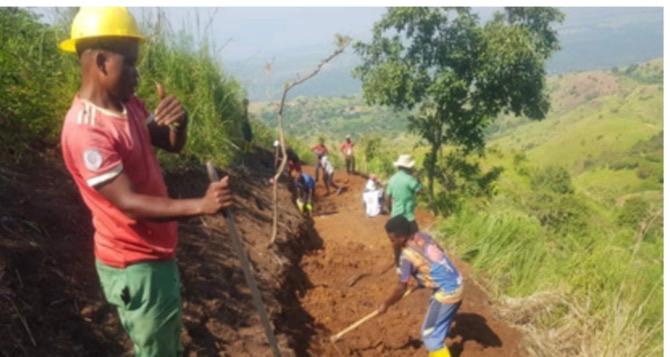
Through these efforts, the road linking Nyakunde (a Bira village) and Bavi-Olongba (a Ngiti village), which had been abandoned and overgrown with vegetation, was rehabilitated and reopened, thereby restoring communication and strengthening social ties between the two communities.
During the project, members of armed groups were also sensitized on the importance of ending hostilities against civilian populations.
Since then, despite persistent tensions that cannot be entirely eliminated, the two communities have continued to maintain contact and interaction through this rehabilitated road.
2.2. AJEDEC’s Role in Managing Customary Leadership Conflicts in the Walendu-Bindi Chiefdom, with Funding from the Ituri Provincial Government
In 2019, AJEDEC was designated by the Bindi community to initiate and facilitate an intra-community dialogue aimed at restoring peace and easing tensions that had intensified to the point of risking violent confrontations among community members.
Initially driven by disputes over customary leadership, these tensions had expanded to include conflicts related to village and groupement boundaries.
To bring together members of the same community who had become deeply divided, AJEDEC conducted extensive community consultations, gathering complaints, grievances, and frustrations from the various parties involved.
After six months of separate working sessions dedicated to in-depth analysis of the issues and the identification of potential solutions, a joint dialogue process became possible.
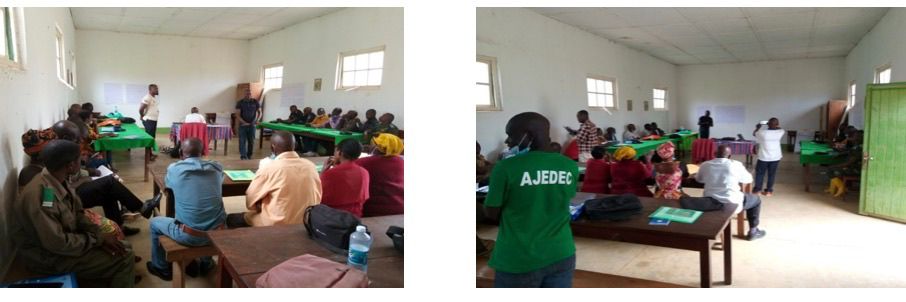
More than 300 members of the Bindi community, representing all groupements and localities, gathered in Gety-Etat for an intra-community dialogue funded by the Ituri Provincial Government.
Following three days of discussions and reconciliation of the findings from the separate community consultations, the dialogue resulted in a set of resolutions that were unanimously endorsed by all participants, who represented their respective communities.
Since then, these resolutions have served as a reference framework for addressing emerging conflicts related to the issues discussed and resolved during the dialogue.
2.3. AJEDEC’s Contribution to Peacebuilding in Djugu Territory: “For a Peaceful Djugu”
Between 2020 and 2022, AJEDEC actively contributed to peacebuilding efforts in Djugu Territory alongside three other humanitarian organizations: the Danish Refugee Council (DRC), which led the consortium, and two national NGOs, Justice Plus and Associturi.
Together, they implemented the project entitled: “For a Peaceful Djugu: Social Cohesion, Economic Reintegration, and the Engagement of Youth and Women for Peacebuilding in Djugu Territory.”
The project was implemented in eight customary entities: Bahema-Nord (Blukwa), Bahema-Badzere (Bule), Bahema-Banywagi (Tchomia), Walendu Djatsi (Pimbo and Fataki), Walendu Tatsi (Masumbuko), Walendu Pitsi (Kpandroma), and Mambisa (Nizi).
Its overall objective was to strengthen social cohesion and intra- and inter-community resilience, with a particular focus on at-risk youth and communities affected by the CODECO movement.
To contribute to this objective, AJEDEC focused on Specific Outcome 2: “Economic reintegration and social cohesion among members of at-risk groups and communities affected by the CODECO movement are improved.”
Socio-economic reintegration was promoted through the establishment of peace-oriented economic units designed to foster social cohesion among community members.
These initiatives included the creation of four agricultural groups in Fataki, bringing together Lendu and Hema members working collaboratively in harmony; six agricultural groups in Kpandroma, composed of Lendu and Ndo-Okebo members from the Budza villages; and two of the eight agricultural groups established in Blukwa and Masumbuko, whose members included both Hema and Lendu participants.
Through continuous dialogue and interaction, young Lendu participants from Masumbuko were accepted into vocational training centers in Largu, located in Bahema-Nord, where they received training in welding and metal fitting.
Village Savings and Loan Associations (VSLAs) were also established and made operational, supported by income-generating activities.
Beyond facilitating access to microcredit, these associations became effective platforms for awareness-raising, dialogue, and discussions on the root causes of conflict, their consequences, and the roles and responsibilities of each community member in rebuilding peace and promoting peaceful coexistence.
More than 2,400 people directly benefited from these interventions.